
Fraudsters don't only chase big corporations. They go after sole proprietors, small firms, families and teenagers, because smaller targets often have fewer safeguards and less time to double-check.
A colleague of ours learned this first-hand. They had filed a trademark application with the Canadian Intellectual Property Office (CIPO), and within weeks someone posing as a CIPO examiner called and emailed them about it. The scam was polished, timely and very convincing. Our colleague paid a fee before realizing what had happened. Fast action got the money back, but many people aren't so lucky.
Here is how that scam worked, two other frauds hitting everyday Canadians right now, what parents of 12- to 17-year-olds should watch for, and where to turn if it happens to you.
Case study: the fake trademark examiner
The scam worked because it was built on real, public information. Trademark applications are published on the Canadian Trademarks Database, including the applicant's name, address, contact details and file number. The fraudsters used all of it.
Here is how it unfolded, all within a few hours:
- A phone call. A friendly, knowledgeable "CIPO examiner" called about the application by its correct file number.
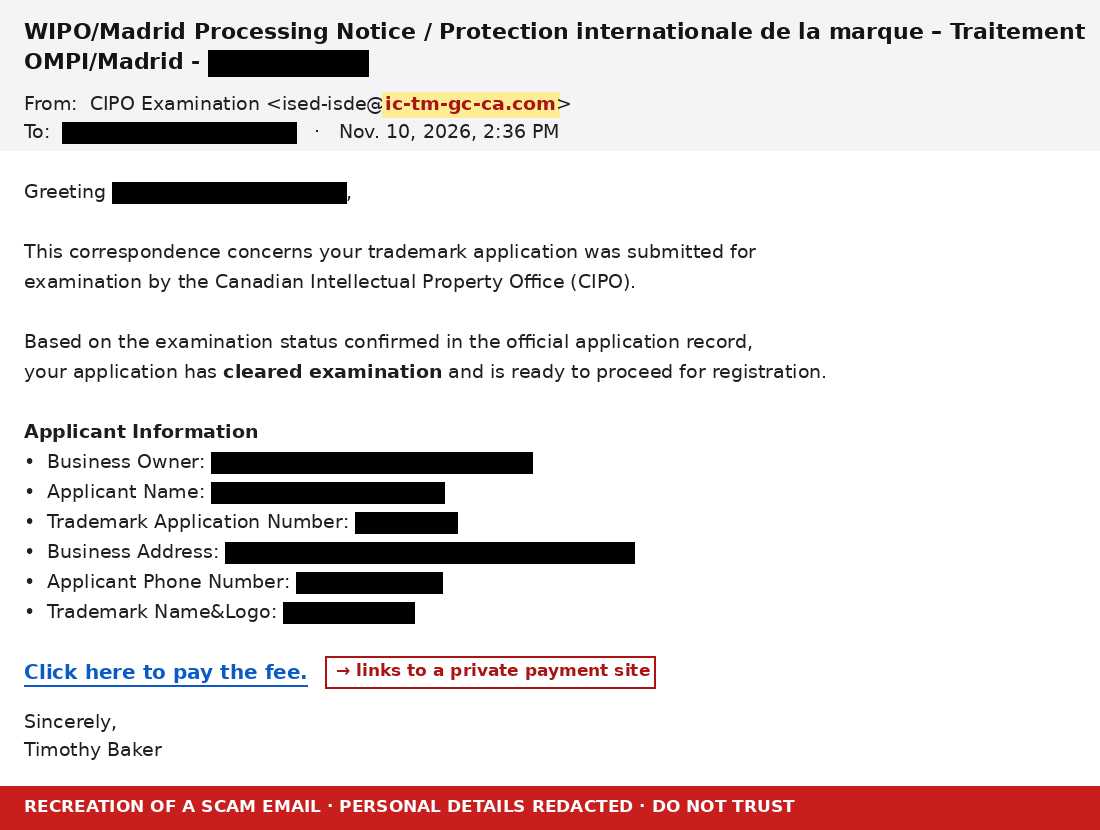
- A "processing notice" by email. It claimed the application had cleared examination and was ready for registration. A link said "Click here to pay the fee."
- A follow-up to build trust. A second email proposed edits to the goods and services description and referred to a genuine letter CIPO had sent weeks earlier.
- The payment. The link led to a payment page on a private website. The fee was charged in US dollars.
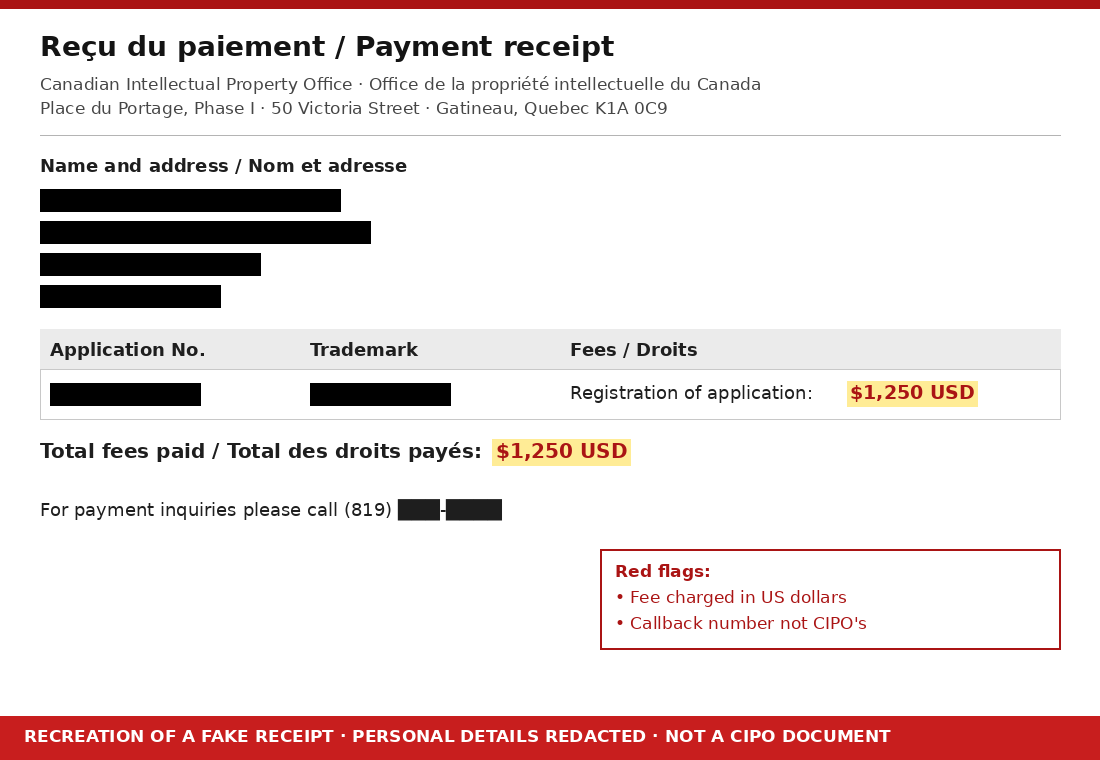
- A fake bilingual receipt. It carried CIPO's real Gatineau address, a "Government of Canada" sign-off and a callback number for "payment inquiries."
The red flags, in hindsight
- The email domain was a lookalike. It ended in ic-tm-gc-ca.com, a private domain built to resemble a government one. Genuine CIPO email comes from @ised-isde.gc.ca.
- One email faked the real address. A message spoofing a genuine @ised-isde.gc.ca sender was flagged by the email filter as a "potential impersonation" and quarantined. The scammers sent it anyway, hoping it would be released.
- The fee was in US dollars. CIPO's fees are in Canadian dollars. For online payments, start from CIPO's official website.
- The status was wrong. The application had not cleared examination. The official file in the Canadian Trademarks Database would have shown that.
- Pressure and speed. A call, three emails and a payment in one afternoon left little time to stop and check.
CIPO itself has warned that scammers are posing as trademark registration services or law firms and sending fake statements of opposition or falsely claiming that proceedings have started against pending applications. Its advice: if you're unsure about correspondence concerning an opposition proceeding, verify directly with CIPO using contact details from its official website, never the ones in the message.
What our colleague did right
They locked the credit card in their banking app that evening, called the bank's fraud line using the number in the app, reported to the Canadian Anti-Fraud Centre, and kept every email as evidence. The bank treated the charge as fraud and cancelled it the next morning.
Below are recreations of two of the scam emails, with identifying details blacked out.
Two other frauds hitting Canadians right now
Canadians reported more than $704 million in fraud losses to the Canadian Anti-Fraud Centre (CAFC) in 2025 (CAFC, 2026), and the CAFC estimates only 5% to 10% of fraud is ever reported (CAFC, 2026). Two types stand out for everyday people and small businesses.
1. The "bank investigator" call
How it works. Someone calls claiming to be from your bank's fraud department, or from the police. They say your account has been compromised and they need your help to catch the criminal, often an "insider" at your branch. You are asked to move money to a "safe account," hand over your card, share a verification code, or keep the whole thing secret. Caller ID may even show your bank's real number.
Why it matters. Canadians reported about $28.6 million lost to this scam in the first six months of 2026 alone, compared with about $37.4 million in all of 2025 (CAFC, 2026).
The tell. Your real bank will never ask you to move money to a safe account, hand your card to a courier, or read out a one-time code. Hang up and call the number on the back of your card or in your banking app.
2. Investment fraud
How it works. It often starts with a social media ad, a direct message, or a new online friend. Fake ads may use doctored videos of well-known Canadians endorsing a crypto or trading platform. The platform shows your money growing, and you are encouraged to invest more. When you try to withdraw, there are sudden "fees" or "taxes," and then the site disappears.
Why it matters. Investment fraud is the costliest fraud reported to the CAFC: $351 million reported lost in 2025 (CAFC, 2026) and about $139.6 million in the first half of 2026 (CAFC, 2026).
The tell. Guaranteed or unusually high returns, pressure to act fast, payment in cryptocurrency, and a platform that is not registered with a Canadian securities regulator. You can check registration at aretheyregistered.ca.
For businesses: watch also for emails that appear to come from a supplier, contractor or your own executive asking to change banking details or rush a payment. Always confirm by phone using a number you already have.
Teens are targets too
Yes, fraudsters go after 12- to 17-year-olds, and the most dangerous scam aimed at them is sextortion. Teens also face scams in games and on social media that look like easy money or free stuff.
Sextortion
Sextortion is blackmail: someone online threatens to share a sexual image or video of a young person unless they pay or send more. In 2024, Cybertip.ca received more than 2,300 sextortion reports, an average of six a day (Cybertip.ca).
What parents should know, from Cybertip.ca's data:
- Boys are the main target. Where gender was known, 83% of victims were male. Boys are usually extorted for money; girls are usually pressured for more images.
- It happens fast. The "new friend" is often a fake profile posing as a teen girl. It can go from first message to threat in hours, sometimes 20 minutes.
- It's organized crime. Money demands often come from international criminal networks. Most incidents start on Instagram or Snapchat.
- AI makes it worse. Offenders are now using ordinary photos from social media to create fake sexual images (Cybertip.ca). A teen doesn't have to have sent anything to be targeted.
If it happens, tell your teen: stop replying, take screenshots, block the account, never pay and never send more, and tell a trusted adult. Paying almost always leads to more demands. Report to Cybertip.ca, which also forwards reports to police. NeedHelpNow.ca helps teens get images taken down.
The most protective thing a parent can say ahead of time: "If anyone ever threatens you online, you will not be in trouble with me. Come to me and we'll fix it together."
Gaming and "easy money" scams
- Free in-game currency or skins offered through links that steal account logins.
- Fake sellers of game items or concert tickets who take payment and vanish.
- "Quick cash" job offers on social media that ask a teen to receive and forward money. This can make them an unwitting money mule for criminals.
The common thread: anything that asks for a password, a verification code, gift cards or a money transfer is a red flag.
Keeping safe: a checklist
Most of these scams share the same ingredients: an unexpected contact, a trusted name, urgency and a request for money or information. These habits break the pattern.
- ☐ Pause before you pay. Urgency is a tactic. A real organization will still be there in an hour.
- ☐ Verify independently. Find the phone number or website yourself, from an official source or the back of your card, never from the message.
- ☐ Check the sender's full address. Look past the display name. A lookalike domain like ic-tm-gc-ca.com is not gc.ca.
- ☐ Never share one-time codes or passwords. No bank, government agency or tech company will ask for them.
- ☐ Never move money to a "safe account" or pay with gift cards or cryptocurrency because a caller told you to.
- ☐ Confirm payment changes by phone. If a supplier or colleague emails new banking details, call them on a number you already have.
- ☐ Turn on two-factor authentication for email, banking and social media.
- ☐ Take your email filter's warnings seriously. Don't release quarantined messages unless you're sure.
- ☐ Know your file. If you have a government application on the go, check its status on the official portal rather than trusting a call or email.
- ☐ Talk to your kids about sextortion and online scams, and make it clear they can come to you without getting in trouble.
- ☐ Watch for "recovery" offers. After a fraud, criminals often return posing as police or a recovery service promising to get your money back for a fee.
Where to report and get help
If you've been targeted, act fast: call your bank first, then report. Speed is often what decides whether money comes back, as it did for our colleague.
| Situation | Who to contact | How |
|---|---|---|
Money sent, or card or account details shared | Your bank or card issuer | Call the number on your card or in your banking app. Ask for the fraud department and lock or cancel the card. |
Any fraud or scam, even with no loss | Canadian Anti-Fraud Centre | Report online or call 1-888-495-8501 |
Money lost or threats made | Your local police | Non-emergency line or online reporting. Keep the report number for your bank. |
A teen being sextorted or exploited online | Cybertip.ca | Report online or call 1-866-658-9022. For image removal: NeedHelpNow.ca |
A young person needs to talk | Kids Help Phone | Call 1-800-668-6868 or text CONNECT to 686868, 24/7 |
Fake trademark or patent correspondence | CIPO | Verify using contact details on CIPO's website |
Scam text messages | Your mobile carrier | Forward the text to 7726 (SPAM) |
Keep the evidence. Save emails, texts, screenshots, phone numbers, receipts and transaction records before deleting or blocking anything. Investigators and banks rely on them.
Be kind to yourself. These schemes are run by organized criminals and are designed to fool careful, intelligent people. Reporting is not embarrassing; it helps stop the next victim.
The bottom line
No one is too small to be a target. Fraudsters now use public records, AI and polished branding to look exactly like the organizations we trust. The best defence is a habit: slow down, verify on your own, and talk openly about it with colleagues, clients and kids.
If you or your business receives correspondence about a trademark, patent or other intellectual property filing and something doesn't feel right, verify directly with CIPO through its official website before you pay or reply.
This post is for general information only and is not legal advice. Statistics are current as of November 2026.
Sources
- Canadian Anti-Fraud Centre, Fraud Prevention Month 2026: Top 10 frauds in 2025
- Canadian Anti-Fraud Centre, Fraud Trends – First 6 Months of 2026 (August 25, 2026)
- Canadian Intellectual Property Office, Trademarks Opposition Board scam alert
- Cybertip.ca, Online Harms: Sextortion

About Juliana Saxberg
Juliana Saxberg is an Ottawa lawyer, founder of Lex Artia Professional Corporation, and legal-tech commentator. Read her author profile →
Recommended Reading
 Words Online Have ConsequencesConsider the privacy and reputational consequences of what we share online.
 When Online Conflict Becomes CyberbullyingRecognize online threats and find public support pathways for targeted harm.
 When the Harm Is Digital but the Damage Is RealExplore why a legal remedy does not erase the harm experienced by a victim.
Copyright & limited reuse
© 2026 Juliana Saxberg and Lex Artia Professional Corporation. Except where otherwise noted, the text of this essay is licensed under Creative Commons Attribution-NonCommercial-NoDerivatives 4.0 International (CC BY-NC-ND 4.0). You may share it with attribution for non-commercial purposes, without adaptations. The LexArtia® name and mark, logos, photographs, illustrations, third-party materials and linked resources are excluded from this licence.